Are you looking to expand your tire recycling operations downstream, or planning to launch a profitable eco-friendly manufacturing project? If so, evaluating your projected rubber tile manufacturing business profit is the crucial first step before committing capital.
Transforming scrap tire crumb into molded rubber tiles is widely recognized as one of the most lucrative sectors within the circular economy. However, raw financial numbers matter most when investing in industrial manufacturing. What does it actually cost to produce one square meter of safety flooring? What net margins can you expect under realistic operating conditions? In this practical financial guide, we break down raw material expenditures, realistic shift capacity, payback timelines, and the true rubber tile manufacturing business profit you can generate with industrial vulcanizing technology.
Raw Material Breakdown: Direct Production Cost per Square Meter
To calculate your overall rubber tile manufacturing business profit, you must first examine direct production costs. A standard production benchmark in the industry is the 500 × 500 × 20 mm dual-layer square or interlocking mat (commonly used in commercial gyms and playgrounds).
Four pieces of these tiles make up exactly 1 square meter (1 m21\text{ m}^2), weighing roughly 18 kg18\text{ kg} to 19 kg19\text{ kg} in total (approximately 4.5 kg4.5\text{ kg} per tile).
Direct Material Cost Breakdown (Per 1 m21\text{ m}^2/ 20mm Tile):
| Material Component | Required Weight () | Average Market Cost ($/kg) | Total Cost () |
|---|---|---|---|
| Base Layer Crumb Rubber (1-3mm) | 14.5 kg | $0.20 - $0.30 | $3.60 |
| Top Layer EPDM/Fine Granules | 3.5 kg | $0.80 - $1.10 | $3.15 |
| Polyurethane (PU) Binder (8-10%) | 1.6 kg | $2.20 - $2.80 | $3.84 |
| Pigments & Color Paste | 0.2 kg | $3.00 | $0.60 |
| Energy & Utilities (Electric Curing) | - | - | $0.45 |
| Direct Labor Allocation | - | - | $0.80 |
| Total Estimated Cost per | - | - | ~$12.44 |
(Note: If you already operate an in-house tire shredder or rubber powder production line , your internal crumb rubber cost drops close to zero, massively elevating your net rubber tile manufacturing business profit).
Selling Prices vs. Net Margins: What Can You Earn?
Commercial demand for impact-absorbing rubber tiles spans gyms, CrossFit boxes, municipal parks, equestrian stables, and outdoor playgrounds.
Depending on your local market, finished 20mm rubber tiles sell at wholesale and commercial project prices ranging from $24.00 to $45.00 per square meter:
- Standard Black Granule Mats (Gyms/Stables): Wholesale price ~22.00−28.00 /m2
- Dual-Layer EPDM Playground Tiles: Wholesale/Project price ~30.00−45.00 /m2
Margin Calculation:
- Gross Revenue per m² (Conservative Mid-range): $30.00
- Total Manufacturing Cost per m²: $12.44
- Gross Margin per m²: $17.56 (Approx. 58% Gross Margin)
Even after factoring in administrative overhead, factory space rent, and local pallet logistics, the net rubber tile manufacturing business profit remains exceptionally healthy compared to simply selling raw rubber powder on the open commodity market.
Production Capacity and Shift Revenue Potential
Your machine selection directly impacts your daily output and your year-end rubber tile manufacturing business profit.
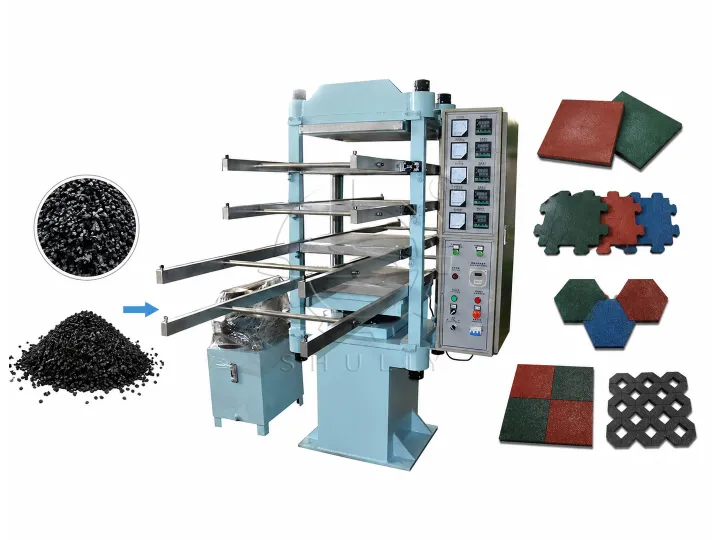
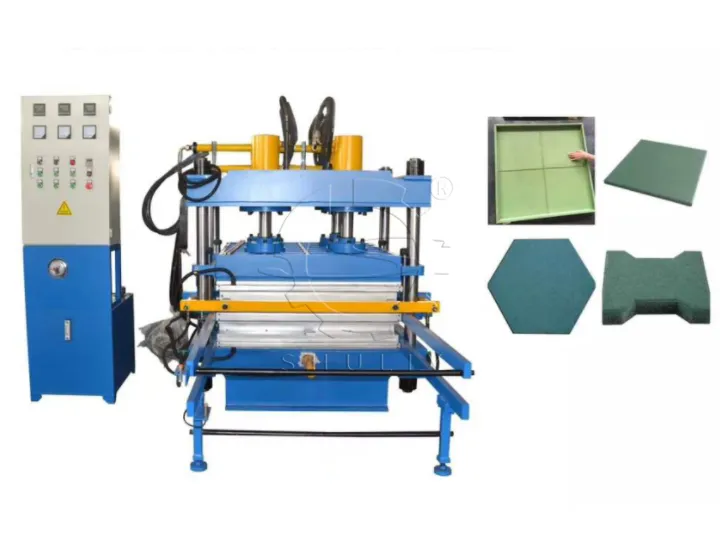
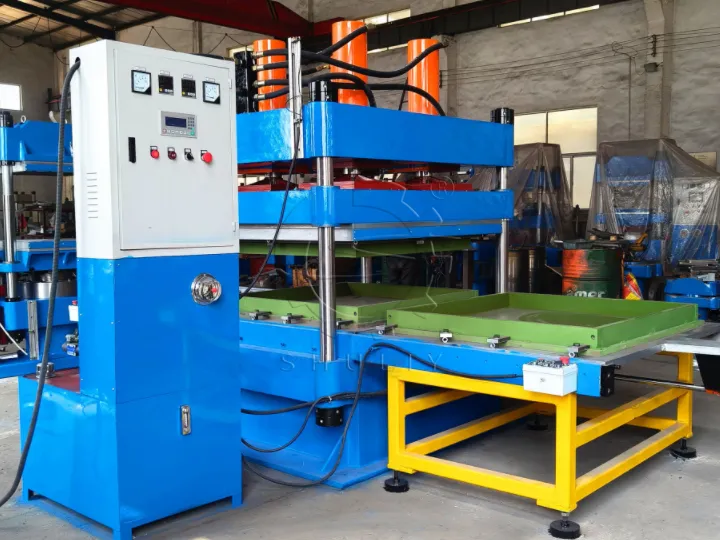
Let us examine the throughput of the popular Shuliy D550 (50-Ton, 4-Layer Hydraulic Press):
- Mold Configuration: 4 layers running simultaneously. Each layer accommodates two 500×500mm molds (8 tiles per cycle).
- Curing Cycle: 5 to 7 minutes per press cycle under 130–140°C thermal plates.
- Theoretical Speed: 8 cycles per hour = roughly 64 tiles/hour (≈16 m²/hour).
Applying Realistic Workshop Efficiency (80% OEE):
In practical plant operations, workers need time for precise manual weighing, surface granule raking, and mold staging. Operating at an industry-standard 80% Overall Equipment Effectiveness (OEE):
- Realistic Hourly Output: ≈12.8 m²/hour
- Single-Shift Output (8 Hours): ≈102.4 m² of finished flooring per day
Monthly Financial Projection (Single Shift / 25 Working Days):
- Monthly Finished Output: ≈2,560 m²
- Monthly Gross Revenue (@ $30/m²): $76,800
- Monthly Operating Production Costs (@ $12.44/m²): $31,846
- Monthly Net Operational Cash Flow: ~$44,954
These operational projections demonstrate why analyzing your rubber tile manufacturing business profit potential makes this one of the quickest value-adding setups in polymer recycling.
ROI Timeline: How Fast Can You Recoup the Machine Investment?
Unlike massive continuous chemical tire pyrolysis plants or mega-scale devulcanization lines that require millions in initial capital expenditure, a dedicated hydraulic rubber tile making machine requires a fraction of the investment while delivering immediate commercial salability.
Equipment Payback Period = Initial Capital Expenditure on Machinery ÷ Monthly Net Operational Cash Flow
Because the baseline hardware investment is modest, the capital expenditure for the core machinery alone is frequently recouped within 2 to 4 months of steady production.
However, prudent factory owners must maintain realistic expectations:
- Working Capital Reserve: Always budget for 2 to 3 months of raw material inventory (crumb rubber, polyurethanes) and local factory utilities.
- Channel Development Phase: Factor in an initial 30-to-60-day ramp-up period to deliver product samples to local flooring contractors, gym designers, and municipal landscape buyers.
Factoring in these commercial ramp-up variables, a comprehensive facility setup consistently achieves full capital amortization well within its first operating year, proving that healthy rubber tile manufacturing business profit can be achieved without excessive risk.
Strategic Ways to Maximize Your Rubber Tile Manufacturing Business Profit
To ensure your facility stays at peak profitability and outpaces regional competitors, smart factory managers implement three specific production strategies:
Close the Loop with In-House Crumb Rubber
Buying processed rubber granules from third-party distributors adds logistics markups. If you install an upstream tire shredder and granulation line, you slash crumb costs by over 50%, capturing maximum rubber tile manufacturing business profit right at the source.
Utilize High-Efficiency Teflon-Coated Molds
Cheap raw steel molds cause sticky demolding issues and high edge-reject rates. Premium Teflon-coated molds eliminate the ongoing cost of liquid release agents, shorten demolding cycles by 40%, and deliver clean, uniform tile edges that command premium retail prices.
Diversify Tile Geometry for Higher Margins
Do not limit your production to standard square pavers. Interlocking “dog-bone” pavers, textured gym tiles, and drainage-base playground mats command 25% to 40% higher retail pricing while using nearly identical raw material inputs, dramatically increasing your net rubber tile manufacturing business profit.
Practical Technical Advice: Controlling Factory Variables
Maximizing your rubber tile manufacturing business profit requires strict attention to workshop temperature and humidity. Single-component polyurethane (PU) binder relies on ambient moisture to cure:
- In hot, humid climates, curing takes place faster; operators must stage and press the mixed crumb before initial adhesive skinning occurs.
- In dry, cold climates, curing can slow down slightly, requiring minor adjustments to the hydraulic plate temperature (typically dialed between 135°C and 145°C).
At Shuliy Machinery, our engineering team provides complete technical formulation parameters alongside our heavy-duty vulcanizing systems to ensure zero material waste from day one.
Partner with Shuliy Machinery for Turnkey Commercial Success
Calculating an attractive rubber tile manufacturing business profit on paper is exciting, but executing it requires rugged, dependable equipment that delivers uniform hydraulic tonnage and precise thermal control around the clock.
At Shuliy Machinery, we design heavy-duty vulcanizing presses and complete recycling lines tailored to your target output. Our machines feature:
- Column-type solid ductile iron frames resistant to high-pressure mechanical fatigue.
- Intelligent dual-zone digital PID thermal control for zero-defect curing.
- Ergonomic slide-rail mold systems that reduce labor overhead and cycle downtime.
Are you ready to calculate your localized rubber tile manufacturing business profit and build a customized facility proposal?
Contact Shuliy Machinery today to receive our comprehensive project equipment specifications, customized plant layout drawings, and a direct factory quotation.